
Ghost vs Medium: Which Blogging Platform Should You Choose in 2026?
Last Updated: February 2026
Ghost is the better choice for creators who want full ownership, custom branding, SEO control, and built-in monetization through paid memberships. Medium is better for writers who want instant access to a large reading audience without managing a website. Ghost costs $9-199/month (or free self-hosted), while Medium is free to publish on but takes a cut of Partner Program earnings.
| Category | Ghost | Medium | Winner |
|---|---|---|---|
| Content ownership | You own everything, full data export | You retain rights but content lives on Medium's domain | Ghost |
| Custom domain & branding | Full custom domain, themes, design control | yourusername.medium.com or custom domain (paid) | Ghost |
| SEO control | Meta tags, structured data, sitemaps, canonical URLs | Limited — Medium controls most SEO elements | Ghost |
| Built-in audience | None — you build from scratch | Large reader network with recommendations | Medium |
| Monetization | Native paid memberships, you keep 100% (minus Stripe fees) | Partner Program based on reading time from paying members | Ghost |
| Newsletter | Built-in email newsletters to members | Basic email notifications, no real newsletter system | Ghost |
| Pricing | $9-199/month managed, or free self-hosted | Free to publish, $5/month membership to read | Depends |
| Ease of setup | Requires hosting setup or Ghost(Pro) subscription | Sign up and start writing immediately | Medium |
| Best for | Professional bloggers, newsletter creators, indie publishers | Casual writers, thought leadership, content marketing | — |
What Are Ghost and Medium, and How Do They Differ Fundamentally?
Ghost is an open-source publishing platform built specifically for professional bloggers, newsletter creators, and independent publishers. You install it on your own server (or use Ghost's managed hosting) and get complete control over design, content, data, and monetization. Ghost launched in 2013 as a Kickstarter project and has grown into the publishing platform behind sites like OpenAI's blog, Cloudflare's blog, and thousands of independent creators.
Medium is a publishing platform and reading network where anyone can create an account and start publishing immediately. Founded by Twitter co-founder Ev Williams in 2012, Medium focuses on connecting writers with readers through its recommendation algorithm and built-in audience network. Writers don't manage their own website — they publish on medium.com.
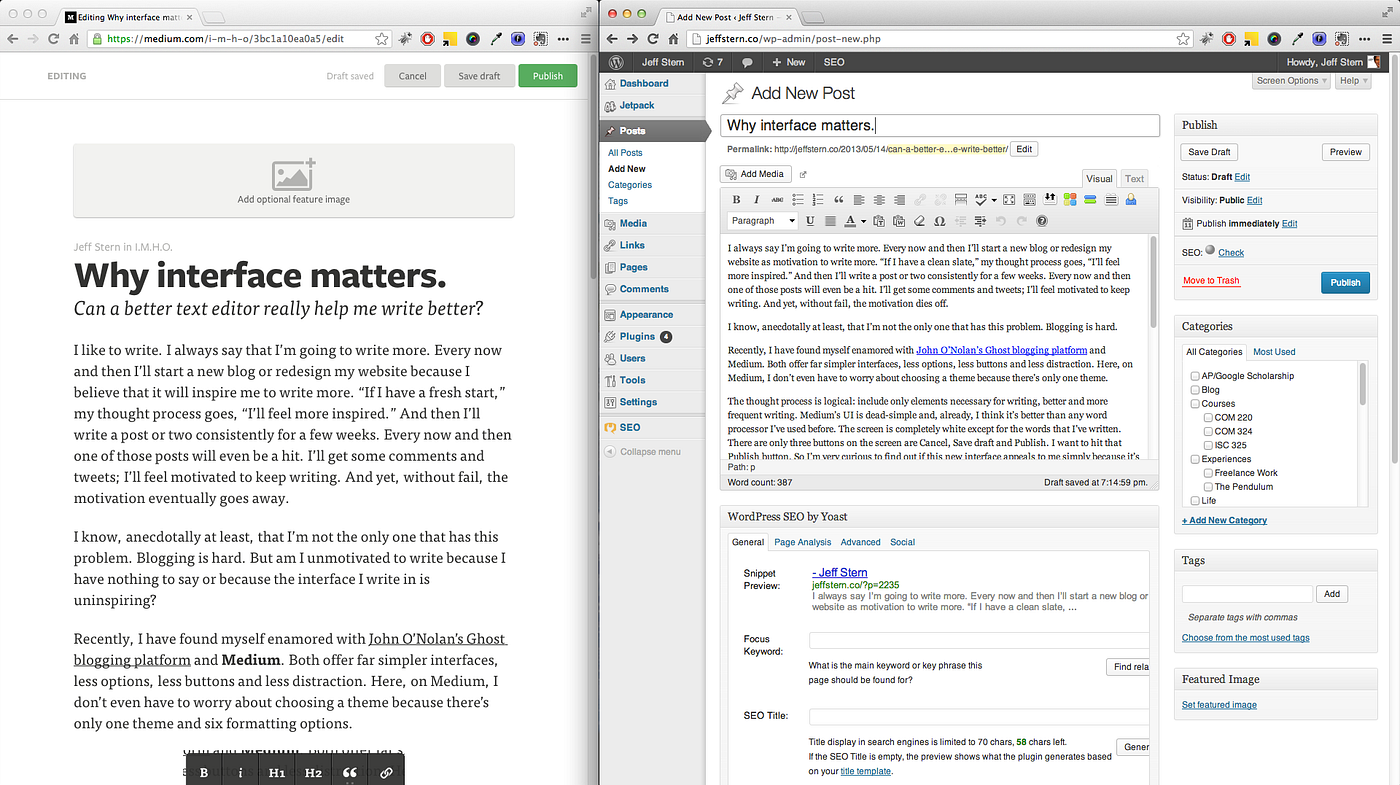
The fundamental difference: Ghost gives you a website you own. Medium gives you a profile on someone else's platform. This distinction affects every downstream decision — from SEO and branding to monetization and data portability.
I've run seocontentai.com on Ghost since 2022 and have published content on Medium as well. After three years of comparing both platforms in practice, the differences become much clearer than what surface-level feature lists suggest.
Which Platform Gives You Better SEO Control?
Ghost provides significantly more SEO control than Medium. This is one of the clearest differentiators between the two platforms and a primary reason I chose Ghost for this blog.
With Ghost, you control every SEO element that matters for search rankings:
- Custom meta titles and descriptions — write unique SEO titles independent of your post title (see our Ghost meta tag guide)
- Clean URL structure — customize slugs, set canonical URLs, control redirects
- Structured data — Ghost outputs JSON-LD schema automatically for articles and authors
- XML sitemaps — auto-generated at /sitemap.xml
- Code injection — add custom scripts, analytics, or schema markup to head/foot
- Image optimization — control alt text, file names, responsive image generation (our image optimization guide)
- Tag-based taxonomy — organize content into topical clusters that strengthen site authority (Ghost tags best practices)
On Medium, you have almost no SEO control. Medium sets the meta title, decides the URL structure (medium.com/username/title-hash), controls the canonical URL, and manages all structured data. You can't add custom schema markup, modify robots.txt, or create a tag-based content architecture. According to Medium's own SEO documentation, the platform handles "most SEO best practices automatically" — which means you're trusting their decisions for your content.
Medium does have high domain authority (DA 95+), which means your articles can rank quickly for competitive terms by borrowing Medium's authority. However, you're building someone else's SEO equity, not your own. If you leave Medium, that ranking power stays with medium.com.
How Much Does Ghost Cost Compared to Medium?
Ghost and Medium have fundamentally different pricing models. Ghost charges for infrastructure (hosting your site), while Medium charges readers for access (and shares revenue with writers).
Ghost Pricing (2026)
| Plan | Monthly Price | Members Included | Staff Users | Best For |
|---|---|---|---|---|
| Self-Hosted | Free (+ hosting costs ~$5-20/month) | Unlimited | Unlimited | Developers, technical users |
| Starter | $9/month | 500 | 1 | Solo bloggers getting started |
| Creator | $25/month | 1,000 | 2 | Growing newsletters |
| Team | $50/month | 1,000 | 5 | Small publications with multiple authors |
| Business | $199/month | 10,000 | Unlimited | Professional media operations |
With Ghost, paid membership revenue goes directly to you. Ghost connects to Stripe for payment processing, and you keep 100% of subscription revenue minus Stripe's standard 2.9% + $0.30 per transaction. Ghost(Pro) takes zero commission on your earnings.
Medium Pricing (2026)
| Role | Cost | What You Get |
|---|---|---|
| Writer (free) | $0 | Publish unlimited articles, basic stats |
| Writer (Partner Program) | $0 to join | Earn from reading time of paying Medium members |
| Reader (membership) | $5/month or $50/year | Unlimited access to paywalled articles |
Medium's Partner Program pays writers based on "reading time" from paying Medium members. According to Medium's Partner Program documentation, earnings vary significantly — some writers report $50-500/month while top performers earn $5,000+. But you have no control over pricing, can't set your own subscription tiers, and Medium decides the revenue split formula.
The key financial difference: Ghost lets you set your own membership price (e.g., $10/month) and keep it all. Medium pools reader subscriptions and distributes earnings based on engagement metrics you can't control.
Which Platform Is Easier to Set Up and Use?
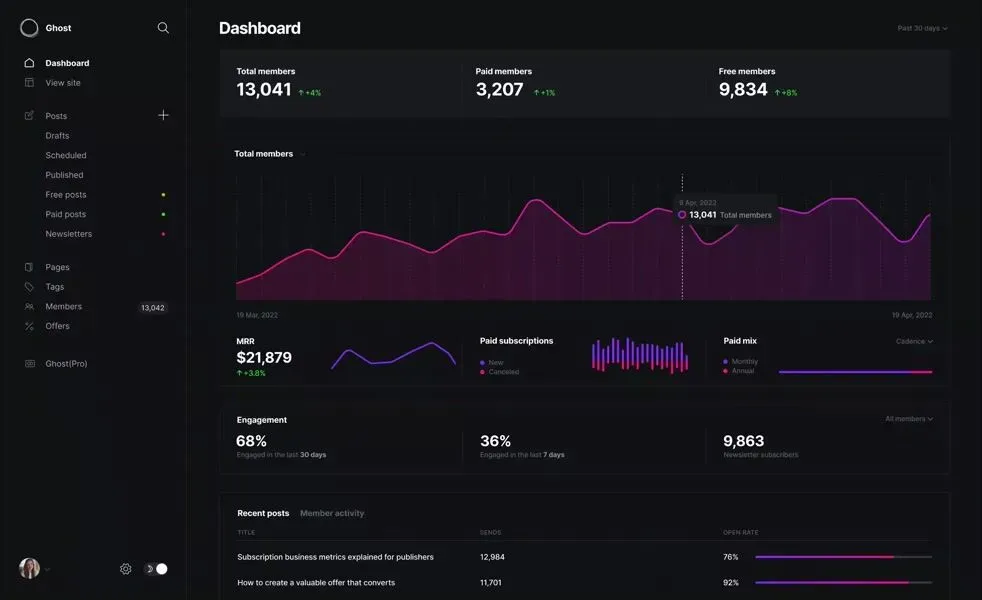
Medium wins on initial setup speed. You create an account, and you're writing within minutes. No hosting, no domain, no configuration. The editor is clean and distraction-free — similar to a Google Doc with formatting tools.
Ghost requires more upfront setup. With Ghost(Pro), you sign up, pick a plan, connect your custom domain, and choose a theme. The whole process takes 15-30 minutes. Self-hosting on a VPS like DigitalOcean requires terminal commands and basic Linux knowledge — roughly 1-2 hours for someone comfortable with command-line tools.
Once set up, both editors are straightforward. Ghost's editor supports Markdown, drag-and-drop images, embeds (YouTube, Twitter, CodePen), and reusable content blocks called "cards" — including HTML cards for custom embeds and table cards for structured data. Medium's editor focuses purely on writing with basic formatting: headings, bold, italic, links, images, and embeds.
For day-to-day writing, both platforms are easy to use. Ghost has a steeper initial setup curve but offers more flexibility once running. Medium has near-zero setup friction but also near-zero customization.
How Do Ghost and Medium Compare for Building an Email Newsletter?
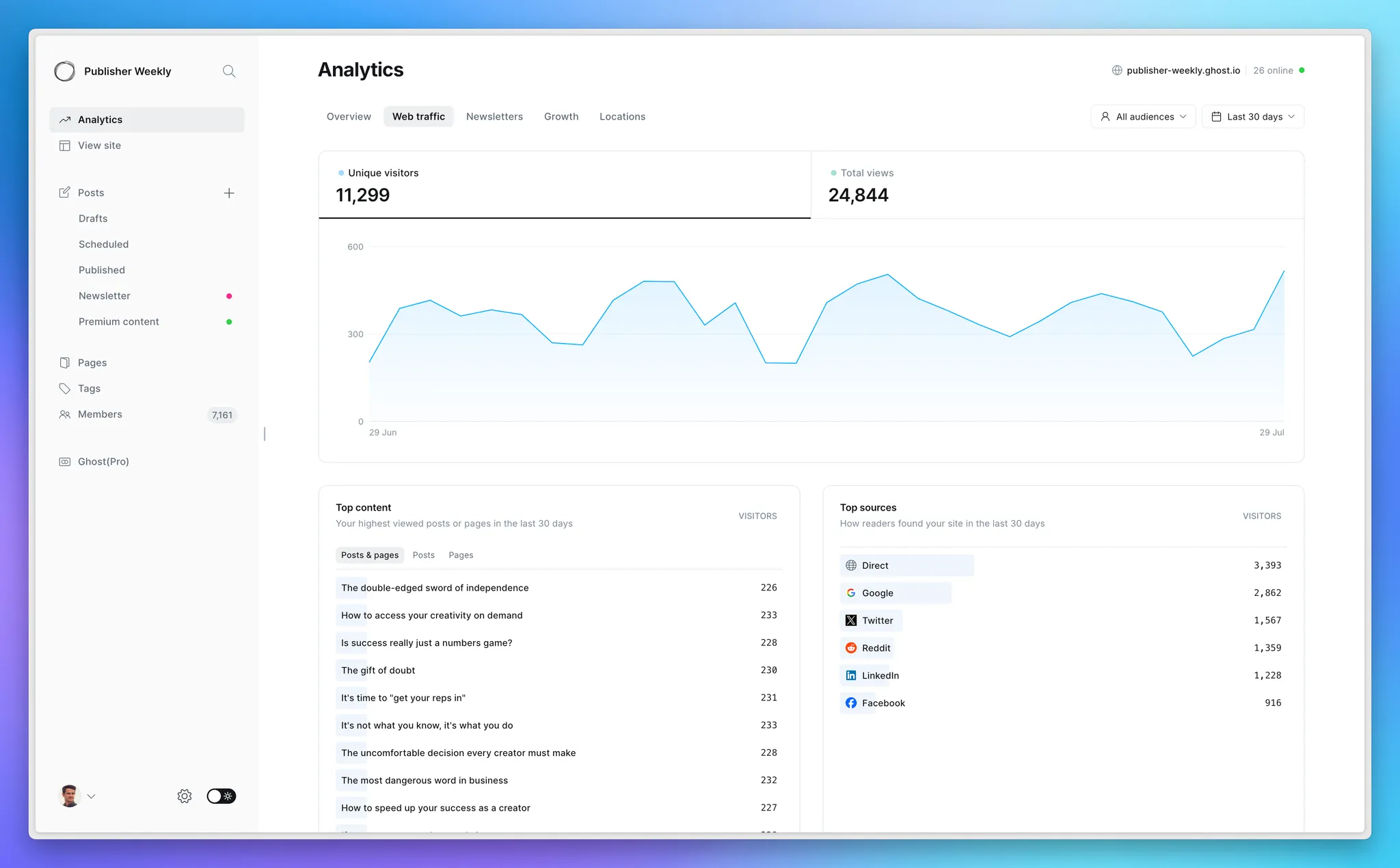
Ghost has a native, built-in email newsletter system that rivals standalone tools like Substack and ConvertKit. Every Ghost blog can collect email subscribers, segment them into free and paid tiers, and send posts directly as newsletters — all without third-party integrations. Ghost handles email delivery through Mailgun, supporting custom sending domains and deliverability tracking.
Medium has no real newsletter system. Writers can "follow" each other, and Medium sends email digests to readers based on algorithmic recommendations. But you can't build a subscriber list, send custom emails, or segment your audience. Medium controls the reader relationship entirely.
This matters because email lists are the most valuable asset a creator can build. If Medium changes its algorithm or shuts down (they've pivoted their business model multiple times since 2012), you lose access to your audience. With Ghost, your subscriber list and email infrastructure are yours — exportable at any time.
For context, Ghost's newsletter capabilities are a major reason publications have been migrating from Substack and Medium to Ghost since 2023. You get the same newsletter functionality without platform dependency.
Which Platform Offers Better Monetization Options?
Ghost's monetization model gives creators significantly more control and earning potential than Medium's Partner Program.
Ghost Monetization Features
- Paid memberships — set monthly and annual prices you choose (e.g., $8/month, $80/year)
- Tiered access — create free, paid, and premium content tiers
- Direct Stripe integration — you keep 100% minus Stripe's 2.9% + $0.30
- Custom offers and discounts — create promotional pricing, trials, and coupons
- Portal — built-in signup/login flow for members, no coding needed
- No platform commission — Ghost takes zero cut of your revenue
Medium Monetization Features
- Partner Program — earn based on reading time from paying Medium members
- Referred memberships — earn a commission when readers you refer become paying Medium members
- No direct pricing control — you can't set your own subscription price
- Opaque revenue formula — Medium determines how the revenue pool is distributed
If you're building a business around your writing, Ghost's model is clearly superior. A Ghost creator with 500 paid members at $10/month earns $5,000/month (minus ~$145 in Stripe fees). A Medium writer needs massive, sustained readership from paying Medium members to approach similar earnings, with no control over the formula.
Medium's advantage is that you don't need to build an audience from zero — Medium's recommendation engine and "related stories" feature can expose your writing to readers who already pay for Medium access. For writers focused on reach rather than direct revenue, this has genuine value.
How Do Design and Customization Compare?
Ghost gives you complete control over your site's appearance. You can choose from hundreds of free and premium themes, customize them with CSS and HTML through the Ghost Admin theme editor, or build a completely custom theme using Ghost's Handlebars-based template system. You can use custom fonts, colors, layouts, navigation, and inject custom code anywhere on the site.
Medium gives you almost no design control. Every Medium post looks like every other Medium post — the same fonts (Charter for body text, Sohne for headings), the same layout, the same black-and-white reading experience. You can add a profile photo and bio, but your publication's visual identity is essentially Medium's identity.
For personal blogs where brand recognition matters, this is a significant limitation. If you're a business, agency, or professional creator, publishing on Medium means your content looks identical to everyone else's on the platform. Ghost lets you create a distinctive visual brand that builds recognition over time.
Who Owns Your Content and Data?
This is arguably the most important consideration, and Ghost's answer is unambiguous: you own everything.
Ghost is open source under the MIT license. Your content, subscriber data, design, and entire site database belong to you. You can export all content as JSON at any time, migrate to a different host, or even fork Ghost's codebase. If Ghost(Pro) disappeared tomorrow, you'd still have your site and data.
On Medium, you retain copyright to your work, but Medium's Terms of Service grant the platform a broad license to distribute, modify, and display your content. Medium can change its algorithmic distribution, paywall policies, or recommendation system at any time — and has done so repeatedly. You can export your posts as HTML via Medium's settings, but you lose all engagement data, follower relationships, and any distribution you built on the platform.
For anyone building a long-term publishing business, ownership isn't negotiable. I've seen creators lose years of audience-building work when platforms change direction. Running on Ghost means that risk doesn't exist.
Can You Use Ghost and Medium Together?
Yes, and many creators do. A practical strategy is to run your primary blog on Ghost (for SEO, newsletters, and paid memberships) while cross-posting selected articles to Medium (for audience discovery).
The key technical detail: when you cross-post to Medium, set the canonical URL to point back to your Ghost post. This tells Google that your Ghost version is the original, preventing duplicate content issues. Medium supports custom canonical URLs in their post settings.
This hybrid approach lets you build SEO equity and email subscribers on your owned Ghost site while tapping into Medium's reader network for discovery. Several large creators use this strategy effectively — publishing on Ghost first, then selectively syndicating to Medium a few days later.
Choose Ghost If...
- You want to own your content, data, and audience relationship
- SEO and organic search traffic are important to your growth strategy
- You plan to monetize through paid memberships or newsletters
- You want a custom-branded website that doesn't look like everyone else's
- You're building a long-term publishing business, not just writing casually
- You need full analytics, member management, and email marketing tools
Choose Medium If...
- You want to start writing immediately with zero setup or costs
- You're focused on thought leadership or content marketing, not direct revenue
- You want exposure to Medium's built-in reading audience
- You're testing ideas before committing to a full publishing platform
- You write as a hobby and don't need custom branding or SEO control
- You don't want to manage hosting, domains, or technical infrastructure
Final Verdict: Ghost vs Medium in 2026
For professional creators, independent publishers, and anyone building a business around content, Ghost is the stronger platform. The combination of full content ownership, native paid memberships (with zero platform commission), built-in newsletters, complete SEO control, and custom branding creates a foundation that scales with your audience. The tradeoff is higher upfront effort — you need to set up hosting, choose a theme, and build your audience from zero.
Medium remains valuable for writers who prioritize reach over ownership. Its built-in audience network, zero-cost publishing, and instant exposure can jumpstart a writing career or support content marketing goals. The tradeoff is giving up control over SEO, design, pricing, audience data, and long-term platform stability.
After running this Ghost blog for three years and publishing on both platforms, my recommendation is clear: if you're serious about building a sustainable content business, start with Ghost. You can always cross-post to Medium for additional discovery. But starting on Medium and trying to migrate later means leaving behind all the SEO authority, reader relationships, and brand recognition you built on someone else's platform.
For more Ghost-specific guides, explore our Ghost SEO optimization guide, Cloudflare caching setup, and Ghost vs Substack comparison.